Over the past 15 years, research into the emerging technology of memristive devices, also known as ReRAM devices or memristors, has grown enormously. These are electronic components that have the ability to store information in the form of resistance, which is modifiable by the voltage applied to their terminals in a non-volatile way.
This technology continues to mature, and today there are several companies around the world that incorporate it into their electronic products and/or innovative solutions. Memristors are also the circuit equivalents of neuronal synapses, and can be used for the development of neuromorphic computers that could greatly enhance artificial intelligence applications.
In parallel, it is being introduced in university laboratories as part of electronics subjects, but at a slower pace than expected. The cost of these devices is still high, compared to others used in the implementation of electronic circuits. In addition, they require rigorous treatment for the development of electronic projects. A memristor “is damaged” when it is no longer able to significantly modify its resistance, ceasing to respond to the applied signals, which means loss of stored information.
For several years, the American company Knowm Inc. marketed a technology of memristive devices, which are encapsulated in a suitable way to be easily used in electronic design projects. The next step to massify the use of this technology in academia, consists of facilitating practical work and electrical characterization, through an easy and safe to use instrumentation kit and also compatible with equipment that are commonly in electronic teaching laboratories.
In this scenario, the researcher from the Advanced Center for Electrical and Electronic Engineering, AC3E, Dr. Ioannis Vourkas, with more than a decade of research experience on memristive devices, works on the development of a platform that would allow the characterization and statistical study of the switching behavior of these devices when modifying their resistance, facilitating the study of their capabilities and limitations, to be considered when using them in electronic projects. “The identification of the range of voltages necessary to apply and the resistances possible to achieve without damaging the devices, requires well-designed experiments that allow to explore and validate the characteristics that the user seeks, which undoubtedly requires supervision and help from an expert,” highlighted the academic.
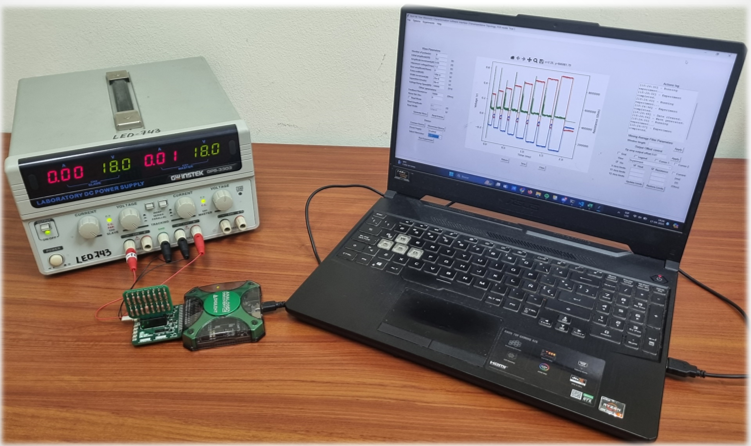
In this challenge, the “RevI-Ve” kit (Visual I-V measurement Environment for ReRAM devices) initiative arises, from an innovation project driven by Dr. Vourkas, together with the Center’s researchers and academics from the Department of Electronics of UTFSM, Dr. Christian Rojas and Dr. Marcelo Perez. It is the development of a system that consists of a graphical interface (software) that allows to use the functionalities of a commercial instrument from the company Digilent, called “Analog Discovery 2 (AD2)”, which is both an oscilloscope and a signal generator. The RevI-Ve platform contemplates a range of circuit topologies to choose from for the control of voltage or current in memristive devices, contributing to research in the academic environment and to those companies that require to approach this technology.
“The kit has software that gathers all the most commonly used experiments for the characterization of memristive devices. The planning of the signals to apply for each experiment usually takes a lot of time, which would no longer be a problem, since the RevI-Ve kit allows them to be carried out in a matter of seconds. In addition, the software offers the option to work with three different circuit topologies, which are developed on a printed circuit board (PCB), designed ad-hoc for the experiments that the software supports, minimizing the possibility of error due to the user,” highlighted Dr. Vourkas.
The RevI-Ve kit is the result of rigorous research and development work, to which AC3E Center engineers and several students from the UTFSM Department of Electronics contributed. In its current version, the kit facilitates experimental work, both for students and researchers not initiated in the field, for safe work with memristive devices minimizing the chances of damaging them. It could be in any research or teaching laboratory, facilitating the incorporation of this subject into the curriculum of basic electronics subjects, massively. “We consider it important to make our kit compatible with Digilent’s portable and low-cost equipment, which has been acquired by many Universities in recent years. Imagine that, in all these institutions, students can learn about memristors using our kit, which could be acquired massively thanks to its low cost, promoting research and the development of innovative ideas around electronics,” said Dr. Vourkas.