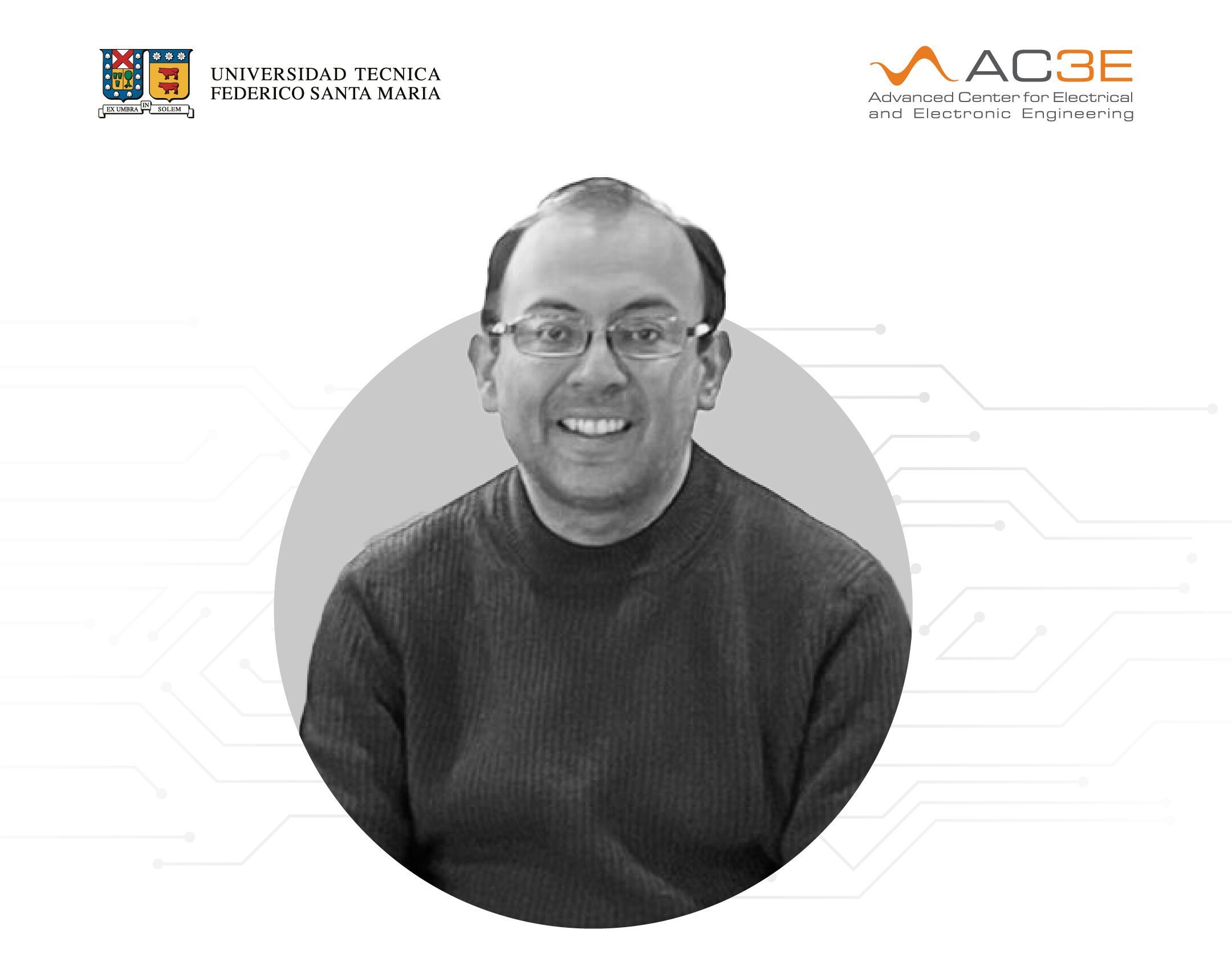
The academic from the Department of Electronics at Federico Santa María Technical University and researcher at the Advanced Center for Electrical and Electronic Engineering, AC3E, Dr. Marcelo Soto, has assumed the position of Tenured Researcher at the Center, leading the Robotics research group, alongside Dr. Marcos Orchard.
Dr. Soto is an Electronic Engineer from UTFSM and holds a Doctorate in Innovative ICT Engineering Technologies, specializing in Telecommunications from Scuola Superiore Sant’Anna di Pisa, Italy. He joined the AC3E team in October 2019 as an associate researcher.
“My experience at the Center has been quite good, as it has allowed me to increase the visibility and recognition of my research, providing me with access to resources and funding to boost high-impact projects, train students, and present our scientific contribution at international conferences. In addition, working with a distinguished group of researchers has helped me establish various collaborations, stimulating scientific creativity in my work,” said Dr. Soto.
The academic has dedicated his career to the research of optical fiber sensors (distributed and point sensors), optical pulse coding techniques, nonlinear optical fiber, optical signal processing, and optical fiber amplification systems.
His main objective now as a tenured researcher is to contribute to the team with his knowledge, promoting projects that contribute to research and technological development in his area of expertise. “I receive the news with a mixture of excitement and gratitude. It is an honor for me to have been considered for the role of Tenured Researcher. I assume this role with a strong sense of responsibility and enthusiasm for the opportunity to contribute to the Center and the country with my experience in optical fiber sensors,” he mentioned.
Assuming this new role, which aims to guide and lead the research group, undoubtedly brings a series of challenges. From this perspective, Dr. Soto hopes to promote technological development initiatives in optical fiber sensors, to provide innovative solutions for the national industry. “I would also like to promote multidisciplinary research in collaboration with other AC3E researchers and throughout the country, using optical fiber sensor technology in new applications. These could cover various fields, such as health, seismology, renewable energies, civil engineering, among others,” he said.
Today, AC3E has endless topics to contribute from Robotics, and specifically, from the field of optical fiber sensors. In this regard, Dr. Marcelo Soto stated that “optical fibers have the potential to provide a distributed monitoring system for a large number of applications. I believe that the Center could contribute in areas of high relevance in the country, incorporating optical fiber sensors in applications such as the monitoring of civil and mechanical structures, electrical distribution, industrial processes, renewable energy generation systems, seismology, security systems and various other areas.”