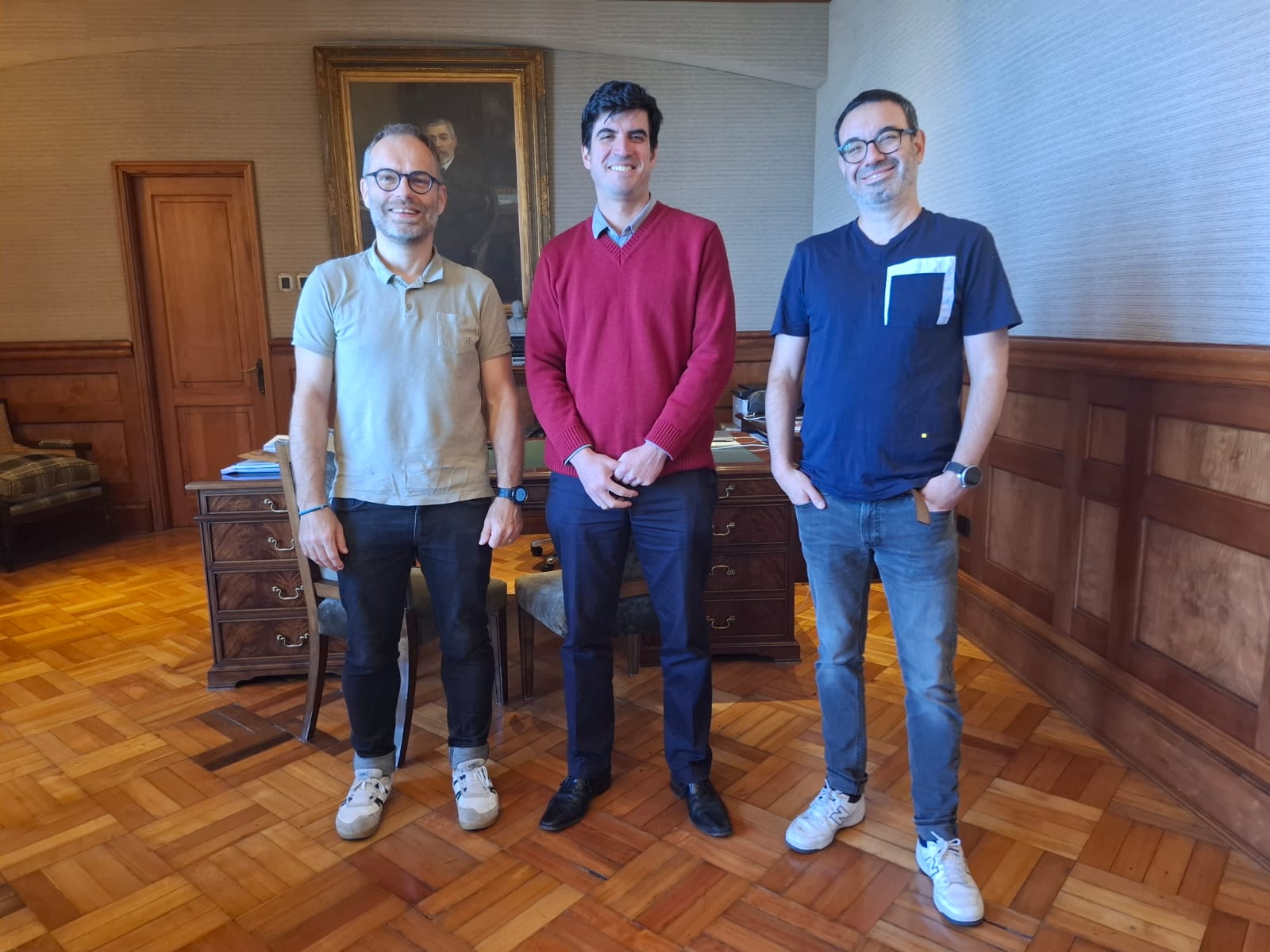
In November, the academic from the School of Engineering of Micromechanics and Microsystems (ENSMM) in Besançon, France, and at FEMTO-ST, Dr. Yann Legorrec, visited the Advanced Center for Electrical and Electronic Engineering, AC3E, within the framework of the research collaboration he has been carrying out for more than 10 years with the Center’s director, Dr. Héctor Ramírez.
This is the fourth time he has visited Chile and AC3E. On this occasion, he was able to see the new facilities: laboratories and workspaces for interaction between academia, industry and students. “It is a very nice and new place to attract more people, companies and young people to work together,” the professor highlighted.
It is worth noting that Dr. Legorrec’s work focuses on topics related to modeling, simulation and control of distributed and nonlinear parameter systems using the Hamiltonian framework. He currently leads a tutoring agreement for doctoral students between Universidad Técnica Federico Santa María and the French school and works with Dr. Ramírez on various research projects, so he took advantage of his stay to advance both initiatives, in addition to inviting new researchers from the Center, specifically from the Control and Automation group, to join collaborations.
“One of the objectives of this collaborative work is to increase the number of students who can benefit from these exchanges and to see the possibility of new research projects related to Hamiltonian systems or similar,” he said.
Although the topics addressed by Dr. Legorrec are mainly theoretical, they are a new approach to the design of control of nonlinear and distributed parameter systems and are applied in different fields of physics such as micro mechatronics, multi-physical systems, energy sciences and electromechanical systems, among others. “Hamiltonian ports are a framework to develop new control designs in fields where traditional methods fail. Our approach uses the laws of physics to develop more robust and easy-to-implement control designs, so they are increasingly used in the automotive industry. In Germany, for example, there are more and more companies that are working with this approach,” shared the visiting academic.