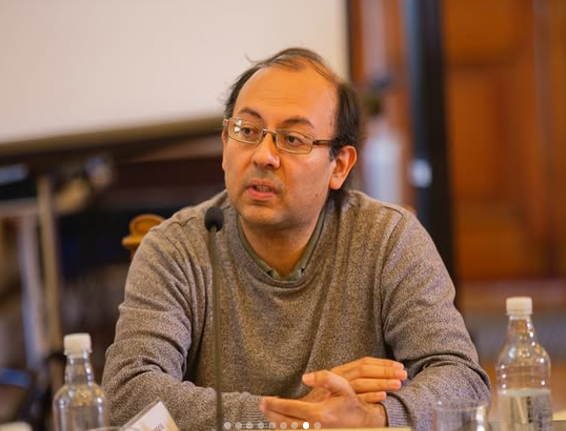
This Monday, November 25th, Dr. Marcelo Soto, researcher from the Advanced Center for Electrical and Electronic Engineering, AC3E, of the Universidad Técnica Federico Santa María, participated in the presentation and formal delivery of the Border Report No. 04, “Use of Submarine Fiber Optics as Seismic Sensors in Chile,” at an event held in the Reading Room of the National Congress Library (BCN) in Santiago. The document was prepared by professionals from the Parliamentary Technical Advisory Section of the National Congress Library, in collaboration with scientists and academics from Valparaíso, Concepción, and Santiago.
The material was delivered to the president of the Senate’s Transportation and Telecommunications Commission, Senator Ximena Ordenes, as a working input for that legislative body. The meeting included a discussion moderated by BCN researcher and report coordinator, Raimundo Roberts, and featured the participation of the Undersecretary of Telecommunications, Claudio Araya; the national director (S) of the National Research and Development Agency (ANID), Fabiola Cid; the director of the National Seismological Center, Sergio Barrientos, and researcher Marcelo Soto from the Center and academic at the Universidad Técnica Federico Santa María.
It is worth noting that Dr. Soto had an active participation in the preparation of this document, which presents the “Distributed Acoustic Sensing” (DAS) technology in optical fiber and its current uses in earthquake research and alert, including tests on submarine cables on the Chilean coasts, a project he led in conjunction with other national and international researchers.
“In mid-2023, I was contacted by the National Congress Library (BCN) as an expert in distributed sensing in optical fiber, to collaborate in the drafting and review of this technical document. This describes two pioneering investigations in Chile related to the application of distributed acoustic sensor technology (DAS: Distributed Acoustic Sensing) for earthquake monitoring using submarine fiber optic cables on the country’s coasts, the latter corresponding to the research we have carried out at AC3E, within the framework of a FONDEF project together with REUNA, Google, and the local company NovelCode,” highlighted Dr. Marcelo Soto.
It is worth noting that the results of this research and other possible applications were announced by the academic in the middle of last year, which included demonstrations that evidenced the capacity of optical fiber to monitor submarine earthquakes on the coasts of Valparaíso, showing its potential as a technology to generate early warnings of earthquakes and tsunamis.
Dr. Soto’s participation in this instance adds to that of other Center researchers in other working groups for the discussion of public policies, which reflects the importance of having a scientific and/or technical vision on various initiatives in which the State is working.
“This activity also allowed us to evaluate possibilities for scientific collaboration with the National Seismological Center to continue advancing in this matter of high social impact related to seismic monitoring with DAS technology in submarine fiber optic cables on the coasts of Chile,” concluded the academic.