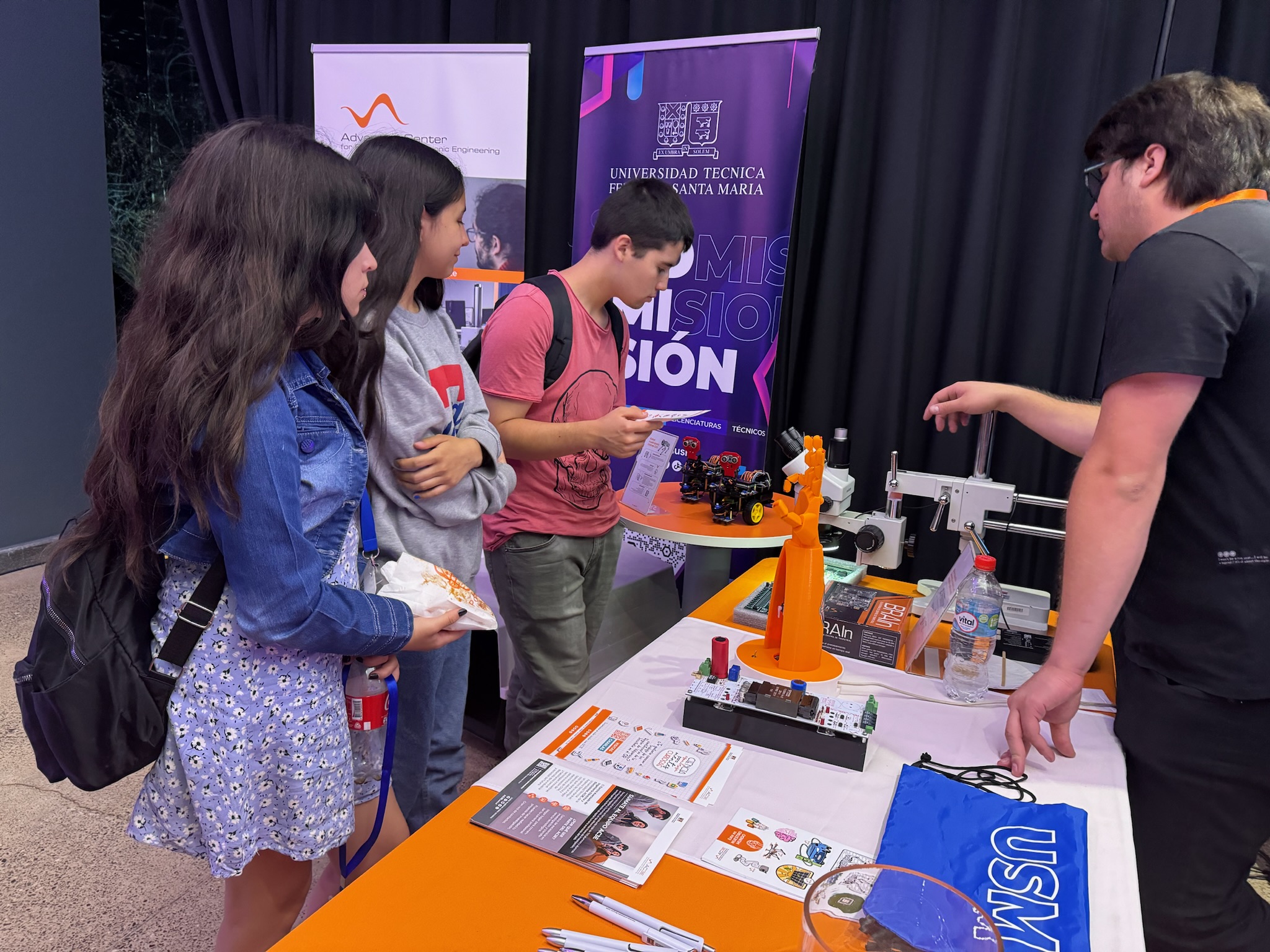
Between January 15th and 20th, a new version of Congreso Futuro took place, a free dissemination platform for knowledge, science, technology, and art, at the CEINA Cultural Center as the main auditorium and in other venues across the country from Arica to Punta Arenas. The Advanced Center for Electrical and Electronic Engineering, AC3E, was invited to participate to disseminate its work and bring science closer to people, through interactive experiences with the thousands of participants.
This event is organized by the Senate of Chile, the Future Meetings Foundation, the Chilean Academy of Sciences, and universities in the country, and aims to be a space where citizens can dialogue and reflect on social, cultural, and political issues that we will face as a society in the near future.
For Dr. Matías Zañartu, director of AC3E, “being at Congreso Futuro is a tremendous opportunity to show people that our country has places where world-class science and technological developments are made that impact the quality of life of people.”
This year, the theme that brought together all the exhibitors and attendees was the incorporation of Artificial Intelligence (AI) and the ethical, governance, opportunities, and challenges it poses for our society, discussions that this year were generated in talks, but also in artistic, literary, technological, and immersive fairs.
AC3E participated with a stand at the Innovation Fair along with 10 other universities and projects, which sought to attract people to learn about the scientific and technological development of our country through interactive exhibitions that encouraged public curiosity. For this, projects such as BRAIn, the innovative and enabling device for the development of industrial electronics in Chile; Doi Smart Sitting, the postural chair with sensors that allows knowing the real well-being of children with neuromotor damage and lack of verbal communication; Unitree Go 1, the dog-like robot that is being used for research in agriculture and other applications, were presented.
The rector of Federico Santa María Technical University, Juan Yuz, gave the talk “Opportunities and challenges in the use of artificial intelligence in higher education” on January 17th, where he reflected on the incorporation of AI as digital transformation and the possibility of exacerbating existing gaps, and also announced how the institution has incorporated this technology into its processes.
Members of the AC3E Research Unit participated as speakers in various talks. Felipe Tobar, associate researcher at AC3E and academic at the University of Chile, presented the talk “Building fairer algorithms: the challenge of incorporating human criteria in artificial intelligence” on January 18th.
For his part, Mauricio Araya, associate researcher at AC3E and professor at UTFSM, participated in the conversation “Artificial Intelligence and the future of work”, along with Jeanne Lafortune, Francisca Gutiérrez, Juan Reutter and Sofía Trejo.
Finally, Patricio Orio, associate researcher at AC3E and professor at the University of Valparaíso, participated in the version held in Valparaíso, in the panel “Neuroscience and new intelligences”, along with Dr. Jorge Gaona, Sebastián Contreras where and the renowned neuroscientist and pioneer in deciphering brain functions, Stanislas Dehaene.